Seattle Whale-Watching Tours: Seasons, Prices, And How To Choose
Three whale-watching trips run from Seattle: two 3 to 5 hour cruises off Elliott Bay and one 10.5 hour Deception Pass combination. Here is how their prices, seasons and review pools actually compare.
Short answer
Seattle whale watching runs on two 3 to 5 hour cruises from 2701 Alaskan Way, from $150 per person and from $154.97, plus a 10.5 hour Deception Pass tour from $368 per person. Bigg's orcas live in Puget Sound year-round and Southern Residents are most reliable April/May through September/October. No tour guarantees a sighting.
What Whale-Watching Tours Depart From Seattle?
Three bookable whale-watching trips depart from Seattle. Two are 3 to 5 hour cruises from 2701 Alaskan Way on the central waterfront, priced from $150 per person and from $154.97. The third is a 10 hour 30 minute Deception Pass combination tour from $368 per person, departing the Sheraton Grand Seattle. Ratings run from 4.5 from 653 reviews to 4.8 from 22.
The two Elliott Bay cruises share a departure address at 2701 Alaskan Way, on the downtown waterfront. The Seattle: Wildlife and Whale Watching Cruise runs 3 to 5 hours, rates 4.5 from 653 reviews, and is priced from $150 per person. The listing carries free cancellation and shows a "Likely to sell out" badge, the only urgency marker of the two short trips.
Its near twin, the Seattle: Half-Day Wildlife and Whale Watching Cruise, leaves the same stretch of waterfront and runs the same 3 to 5 hours. It rates 4.3 from 390 reviews, and its listing shows "Booked 3 times today". The price reads from $154.97, and confirm on the booking page whether that rate is charged per person or per group, and check your party's exact total at checkout the booking, a detail worth confirming before you commit. Free cancellation applies on this listing as well.
The third product is different in kind, not just in length. The Whale Watching + Deception Pass Tour from Seattle departs the Sheraton Grand Seattle rather than the waterfront, runs 10 hours 30 minutes, and costs from $368 per person. It rates 4.8, but from just 22 reviews, a pool small enough that the number tells you far less than the 653 reviews behind the 4.5 on the main Elliott Bay cruise. Its listing carries "Booked 2 times today" and free cancellation.
Across the roster on Seattle Boat Tours, these three are the only dedicated whale-watching products; everything else leaving this waterfront is sightseeing, locks transits, sailing or dining. Whale trips also depart Edmonds, north of the city, where Puget Sound Express lists half-day tours at $155 per adult with that operator's own sighting guarantee. That is context for the wider market around Seattle, not a product this site sells.
One naming note before you compare: both Elliott Bay listings are sold as wildlife cruises, with whales as the headline draw and the Salish Sea's wider marine life as part of the pitch. If whales are the whole point of your day, the sections below sort out which trip, which month and which expectations fit.
When To See Whales In Seattle: Season Windows By Species
Bigg's, or transient, orcas live in Puget Sound year-round, so the region holds some killer whales in every month. Southern Resident killer whales are most reliably present April/May through September/October, humpbacks May through October, and gray whales February through May. Each window is a likelihood, never a promise; no month guarantees any species.
The most useful fact for planning is that Puget Sound has two killer whale populations with completely different calendars. Bigg's transients have steadily increased their use of inland waters over recent decades and are now the more dependable orca encounter for tours. The endangered Southern Resident population is most reliably in the wider Salish Sea during the warm months, which is why summer is when the marketing gets loudest and the boats get fullest.
| Species | Most Likely Window | What The Window Means |
|---|---|---|
| Bigg's (transient) orcas | Year-round | The most dependable orca presence in Puget Sound |
| Southern Resident killer whales | April/May to September/October | Endangered population, most reliable in the warm months |
| Humpback whales | May to October | Numbers build through summer, surface activity often peaks late in the season |
| Gray whales | February to May | The "Sounders" group detours into North Puget Sound on the northern migration |
The gray whale window is the one most travelers miss. The "Sounders" group detours into North Puget Sound on their northern migration to feed on ghost shrimp, which puts gray whales within reach of Seattle-area tours in late winter and early spring, months when the orca conversation is quiet. Humpbacks work the opposite schedule: they build through summer, and surface activity often peaks late in the season.
None of this is a promise. A window says when a species is most likely present in the region, not where any animal will be on your particular afternoon. Weather, tides and the simple movement of wild animals decide what a single cruise sees. If you are weighing dates, the deeper month-by-month breakdown in the best month for whale watching is the companion read, and which whales are in Puget Sound now covers the live-sightings question.
Whichever window you target, all three listings carry free cancellation, so a season mismatch costs nothing to fix if your plans move before the trip. The practical play for a first visit is the warm months, when the most species windows overlap; the contrarian play is February to May, when the gray whale run and year-round Bigg's orcas give the shoulder season something the summer crowds never see.
How The Three Seattle Whale-Watching Cruises Compare
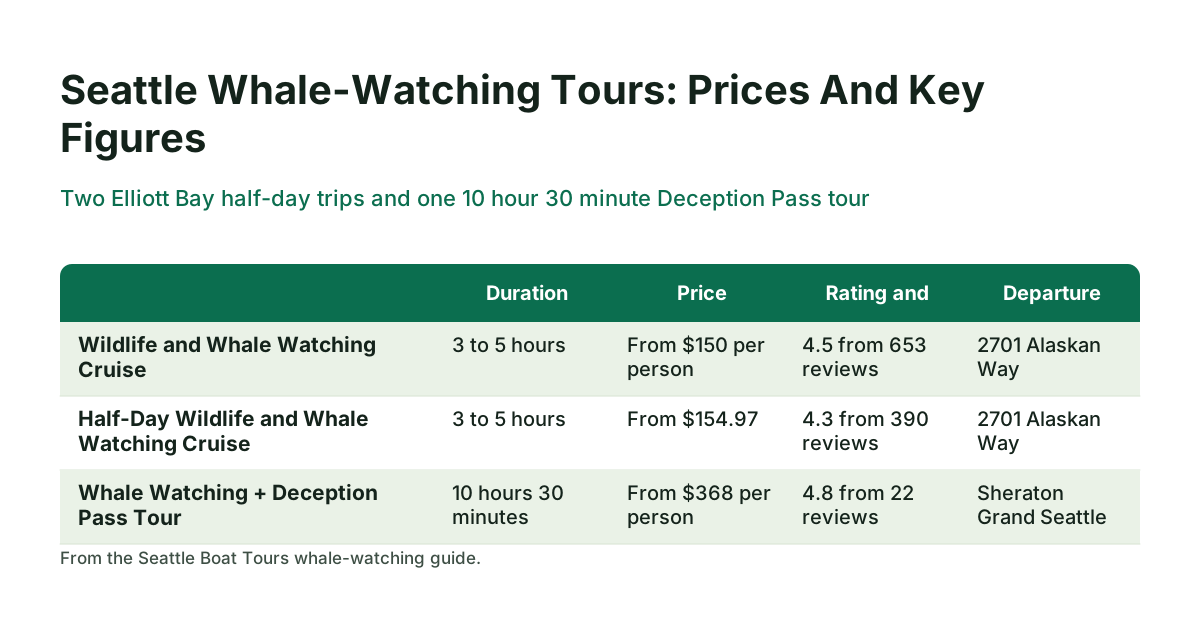
The two Elliott Bay cruises cost from $150 per person and from $154.97 and keep you on the water 3 to 5 hours. The Deception Pass tour costs from $368 per person over 10 hours 30 minutes and adds a second destination to the whale search. All three listings carry free cancellation and depart from downtown meeting points.
| Tour | Duration | Price | Rating And Reviews | Departure |
|---|---|---|---|---|
| Wildlife and Whale Watching Cruise | 3 to 5 hours | From $150 per person | 4.5 from 653 reviews | 2701 Alaskan Way |
| Half-Day Wildlife and Whale Watching Cruise | 3 to 5 hours | From $154.97 | 4.3 from 390 reviews | 2701 Alaskan Wy |
| Whale Watching + Deception Pass Tour | 10 hours 30 minutes | From $368 per person | 4.8 from 22 reviews | Sheraton Grand Seattle |
The two short trips are close substitutes on paper, and the differences are mostly in the details. The wildlife cruise states its price per person, from $150, which makes party budgeting simple. The half-day listing prices from $154.97 without stating a per-person or per-group basis, so compare the final total for your group at checkout rather than assuming either way. Both leave the same waterfront address, both run 3 to 5 hours, and both carry free cancellation.
One marketing figure deserves a plain-language footnote. The wildlife cruise's operator advertises a 97 percent sighting rate on its own listing; that is the operator's marketing claim, not an independent count, and no rate tells you what your own cruise will see on your own afternoon. Treat it as a reason the listing reviews skew positive, not as a contract.
The urgency badges are real and worth reading plainly: "Likely to sell out" on the wildlife cruise and "Booked 3 times today" on the half-day. On a summer weekend that is a genuine signal to book ahead; with free cancellation on both, booking early costs you nothing if the forecast turns. Full details for the headline trip are on the wildlife and whale watching cruise page, or Check availability against your dates.
The half-day listing is the quieter twin, and that is its whole appeal: same waters, same 3 to 5 hour format, slightly smaller review pool at 4.3 from 390, and a price within a few dollars of its sibling once the basis question is settled.
A practical note on the 3 to 5 hour range: your trip length can move with conditions and with where the animals are that day, so plan the full half day rather than a hard two-hour slot. The Deception Pass tour sits in a different category entirely, and the section below takes it on its own terms rather than comparing it line for line against half-day trips.
The 1,000-Yard Orca Rules That Shape Every Puget Sound Cruise
Washington law keeps every vessel 1,000 yards from Southern Resident killer whales, under 7 knots within half a mile of them, and engines disengaged if they surface within 400 yards. Other orca ecotypes, including Bigg's, carry a 200 yard minimum. Commercial whale-watching boats follow the same law as private boats.
These distances are not operator policy that varies by company. They are state law, set under SB 5371 and RCW 77.15.740 on top of the federal baseline, and they have applied to all vessels, commercial tours and paddlers included, since January 1, 2025. The Be Whale Wise regulations publish the full rule set, and the Washington Department of Fish and Wildlife enforces them.
| Situation | The Rule |
|---|---|
| Approaching Southern Resident killer whales | Stay at least 1,000 yards away |
| Within half a mile of Southern Residents | Travel under 7 knots |
| Southern Residents surface within 400 yards | Disengage the engine's transmission |
| Any other orca ecotype, including Bigg's | Stay at least 200 yards away |
What this means on the water: your boat will not close in on Southern Residents, full stop. Killer whale watching in Washington is a long-distance activity by design, which is why binoculars earn their space in your bag and why a good naturalist on the microphone matters as much as a close approach ever did. Bigg's encounters can happen at 200 yards and up, which is a different experience from the old image of boats idling beside a dorsal fin.
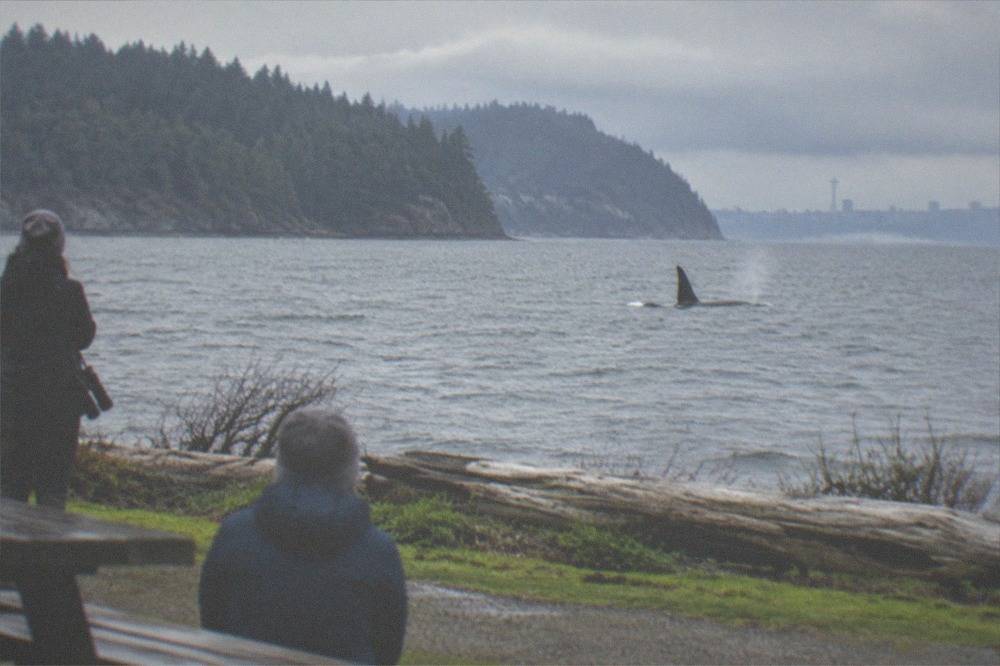
Commercial whale watching in Washington is a licensed activity, and the state licensing rules for commercial whale watching are the reason the boats you board operate to a standard rather than to whatever distance the captain judges. The rules exist because the Southern Resident population is endangered, and the distance is the point: the law trades closeness for the population's recovery.
If a 1,000 yard minimum sounds like it spoils the trip, flip the framing. The rule is why the whales keep coming back to these waters at all, and a boat full of people watching respectfully at distance is the experience the law is protecting. The next section covers what is actually in the Sound when you go.
What You Actually Might See On Puget Sound
Puget Sound whale trips report four whale groups: Bigg's orcas year-round, Southern Residents most reliably April/May through September/October, humpbacks May through October, and gray whales February through May, plus the Salish Sea's wider marine wildlife. The provisional July 2026 census counted 76 Southern Residents, up two from 74 in July 2025.
The census number is the quiet headline. A population that hovered in the mid-70s for years counted 76 in the provisional July 2026 census, with no reported adult or juvenile deaths in the prior year and multiple calves documented. Two whales is not a recovery, but for a population this small, every upward tick changes what a summer cruise might encounter.
Bigg's orcas are the other side of that story, and in practice they are often the orcas a Seattle tour actually finds. Multiple matrilines, the T36s, T37s and T19s among them, were reported across Puget Sound through 2026, and their steady increase in inland waters over recent decades is the single biggest change in the region's whale watching.
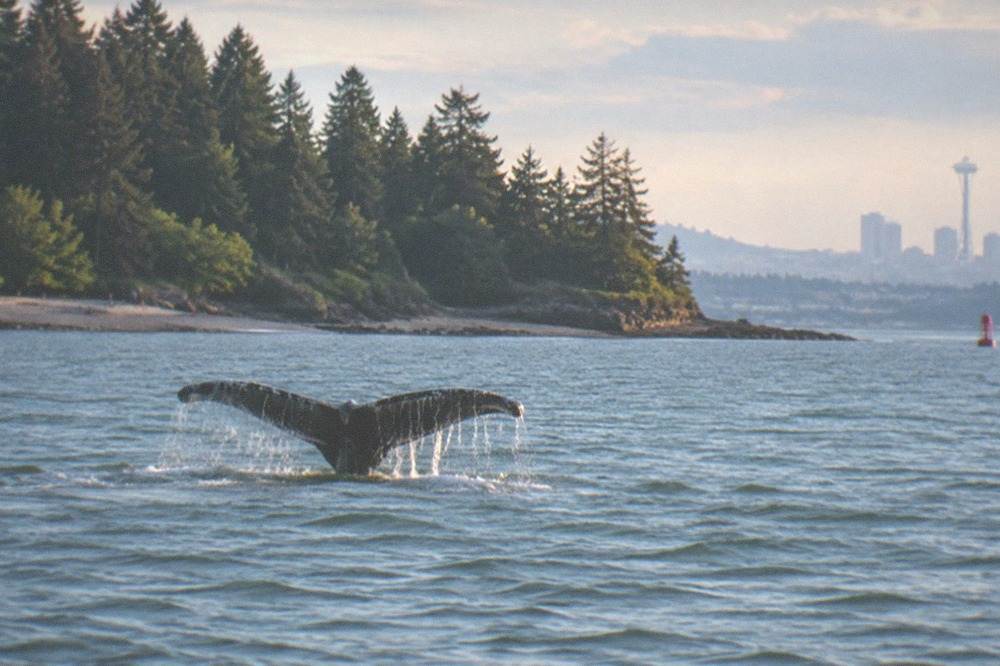
Humpbacks and grays round out the calendar. Humpback numbers build through summer with surface activity often peaking late in the season, while the gray whale "Sounders" group works North Puget Sound from February to May, feeding on ghost shrimp in the shallows. The wider ecosystem has grown its own cultural layer too: a separate Indigenous-led storytelling tour, First Stories of the Salish Sea, launched from Elliott Bay in June 2026 built around Coast Salish perspectives on the same waters.
Whether any of that adds up to a good day out is the fair question, and whether whale watching in Seattle is worth it takes it on directly, including what the reviews say about the reality versus the brochure.
Half-Day Elliott Bay Trip Or Full-Day Deception Pass Tour?
The half-day cruises spend 3 to 5 hours on the water and hand you back the rest of your day. The Deception Pass tour spends 10 hours 30 minutes and pairs the whale search with the pass itself. It rates 4.8 from 22 reviews, a small pool that says less than the same number would over hundreds of trips.
The full-day tour is the only one of the three that bundles two destinations. It leaves the Sheraton Grand Seattle, spends 10 hours 30 minutes door to door, and combines the whale search with time at Deception Pass, the storied strait to the north. At from $368 per person it costs more than both Elliott Bay cruises combined, which is the honest framing: you are buying a day, not a better whale trip.
| Format | Time Commitment | What You Trade | Who It Suits |
|---|---|---|---|
| Half-day Elliott Bay cruise | 3 to 5 hours on the water | One wildlife focus, no second stop | Visitors with a half day and a city itinerary still to fill |
| Full-day Deception Pass tour | 10 hours 30 minutes door to door | Most of a day, at a higher price than both short trips combined | Travelers who want whales plus a second destination in one booking |
The review pool deserves plain speech. The Deception Pass tour rates 4.8, but from 22 reviews, so the score is a strong start rather than a settled verdict; the wildlife cruise's 4.5 from 653 reviews is the more reliable number on this page. With only 22 trips reviewed, treat the rating as one signal among several, and read the recent reviews on the listing before committing a full day.

For a 10.5 hour day, plan like it is a 10.5 hour day: meals and pacing matter as much as the wildlife, and the listing carries free cancellation if your Seattle schedule tightens. The half-day trips ask far less of your calendar, which is why they suit most first visits, while the combo tour earns its keep when the pass itself is on your list and a whole day on the water sounds like the point rather than the cost.
Planning Your Seattle Whale-Watching Day
Book a 3 to 5 hour cruise from 2701 Alaskan Way for a half-day plan, and the Deception Pass tour only when a full day fits. High season runs roughly April/May through October; many operators trim or pause schedules November through March. Dress in layers and confirm your date on the listing before building a day around it.
The seasonal pattern matters more here than on any other boat format on this site, because whale trips run to the animals' calendar, not the city's. Seattle's boating high season runs roughly April/May through October, aligned with longer daylight and the Port of Seattle's cruise season, and many operators reduce or suspend regular sailings November through March. Confirm the dates you want actually run before you plan flights around them.
What you wear is the other half of the day. The Sound is cool on the water even in August, and a trip that runs 3 to 5 hours outlasts any jacket decision made on a warm dock; what to wear on a Seattle boat cruise has the full layering rundown. Binoculars, sunscreen and a filled water bottle cover most of the rest.
Booking timing follows the badges. "Likely to sell out" on the wildlife cruise and "Booked 3 times today" on the half-day are live signals from the listings, and summer weekends justify booking early; with free cancellation on all three tours, an early booking is the cheap option, not the risky one. The gray whale window from February to May is the shoulder-season play for travelers who would rather have quieter boats than peak-month odds.
The short version of all of it: pick your month from the species table, pick your format from your calendar, and let the free cancellation on every listing absorb the planning risk. The questions below cover the ones travelers ask most before they book.
Common Questions About Whale Watching In Seattle
What Is The Best Month For Whale Watching In Seattle?
There is no single best month, only best months per species. Bigg's orcas are present year-round, Southern Residents are most reliable April/May through September/October, humpbacks run May through October, and gray whales pass February through May. The warm months stack the most windows at once; the full breakdown sits in the season section above.
Are There Whales In Puget Sound Year-Round?
Yes, Bigg's (transient) killer whales live in Puget Sound year-round and have steadily increased their use of inland waters. Southern Residents, humpbacks and gray whales are seasonal, each with its own window, and the provisional July 2026 census counted 76 Southern Residents in the wider Salish Sea population.
How Close Can A Whale-Watching Boat Get To Orcas?
For Southern Resident killer whales the law requires 1,000 yards minimum, under 7 knots within half a mile, and engines disengaged if they surface within 400 yards. Other orca ecotypes, including Bigg's, carry a 200 yard minimum. Tour boats follow the same rules as every other vessel.
Do Seattle Whale-Watching Tours Guarantee A Sighting?
No listing on this roster promises a sighting, and this site never states one as a fact. One operator advertises a 97 percent sighting rate as its own marketing figure. Where operators anywhere in this market use the word guarantee, read the terms on the listing before relying on it.
Is Whale Watching In Seattle Worth The Cost?
From $150 per person for a 3 to 5 hour cruise, the price sits mid-range for a half-day activity in this city, and both Elliott Bay trips rate 4.5 from 653 reviews and 4.3 from 390. Worth depends on expectations: distance viewing by law, wild animals on their own schedule, and a half day on the Sound either way.